A commission check that swings between $1,800 one month and $5,200 the next makes a standard monthly budget nearly useless. Fixed-income advice assumes a number that repeats. Commission income assumes almost the opposite. Here’s how to build a budget that actually holds up.
Find your floor month
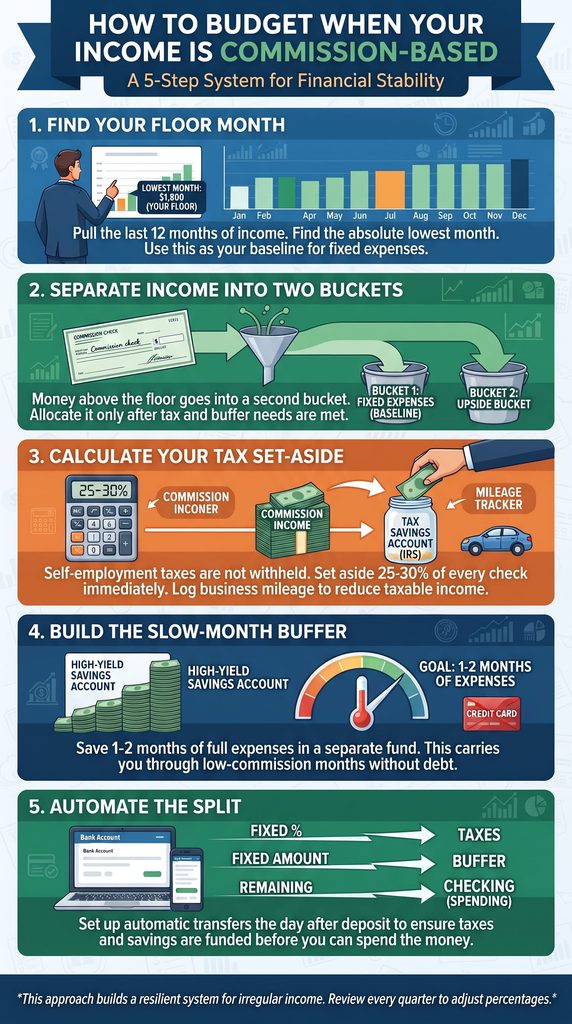
Pull your last twelve months of commission income. Find the lowest-earning month. Not the average, not the median. The floor.
That number is your baseline. Build your fixed expenses around it. Rent, insurance, minimum debt payments, groceries, utilities. Everything that has to get paid no matter what.
If your floor month can’t cover your fixed costs, you have a different problem to solve first. Either cut fixed expenses or find a way to raise your floor. A budget built on money you might not earn is a budget that fails the first slow month.
Separate your income into two buckets
Every commission check that lands above your floor goes into a second bucket. Call it the upside bucket. This money does not go toward your normal monthly spending. It has three jobs, in this order:
- Tax set-aside. If you’re a 1099 contractor, nothing has been withheld. Set aside 25-30% of every check the moment it arrives. Move it to a separate savings account you don’t touch.
- Buffer. Build one to two months of full expenses in a slow-month fund. This is what carries you through the next floor month without touching credit cards.
- Everything else. Debt payoff, investing, or planned spending. Only after the first two jobs are funded.
Calculate your tax set-aside
The IRS treats self-employed income differently from a W-2 paycheck. You owe a 15.3% self-employment tax for Social Security and Medicare, on top of ordinary federal income tax. Most tax preparers recommend setting aside 25-30% of each commission check to cover both.
If you drive for client meetings or work-related travel, you can offset part of that. The IRS standard mileage rate for 2026 is 72.5 cents per mile, up from 70 cents in 2025. Log every mile. Each one reduces your taxable income.
Build the slow-month buffer
The buffer is what makes the whole system work. Without it, one bad quarter forces you onto credit cards or into missed bills. That defeats the purpose of budgeting off your floor.
Aim for one full month of expenses first. Then two. Keep it in a separate high-yield savings account. Label it something you won’t raid, like “slow month fund” or “income gap fund.”
Fund this before you pay down extra debt. Fund it before you invest more. Fund it before you upgrade anything. The buffer protects everything else you’re trying to build.
Automate the split
Set up an automatic transfer the day after each commission deposit. A fixed percentage goes to the tax account. A fixed amount goes to the buffer until it’s full. The rest stays in checking for normal spending and the upside bucket.
Manual transfers fail because they depend on you remembering to do them when a big check lands. A big check feels like a windfall. That’s exactly when you’re most likely to skip the set-aside.
Review every quarter
Once a quarter, look at three things. Whether your floor is still accurate, whether the buffer is funded, and whether your tax set-aside matches what you’ll owe. Adjust the percentages if your income pattern has changed.
For the underlying framework this approach is built on, see this guide to budgeting with irregular income.
Commission income rewards patience more than any spreadsheet trick. The floor, the tax set-aside, and the buffer aren’t separate tactics. They’re one system. Skip any one and the others tend to fall apart during the next slow month.