Getting hit by a driver who cannot pay for the damage is more common than most policyholders assume. A surprising number of drivers only discover this coverage exists after they need it. Uninsured and underinsured motorist coverage exists specifically for that gap. It is one of the few add-ons on an auto policy worth carrying at a meaningful limit rather than the state minimum.
Why uninsured motorist coverage exists at all
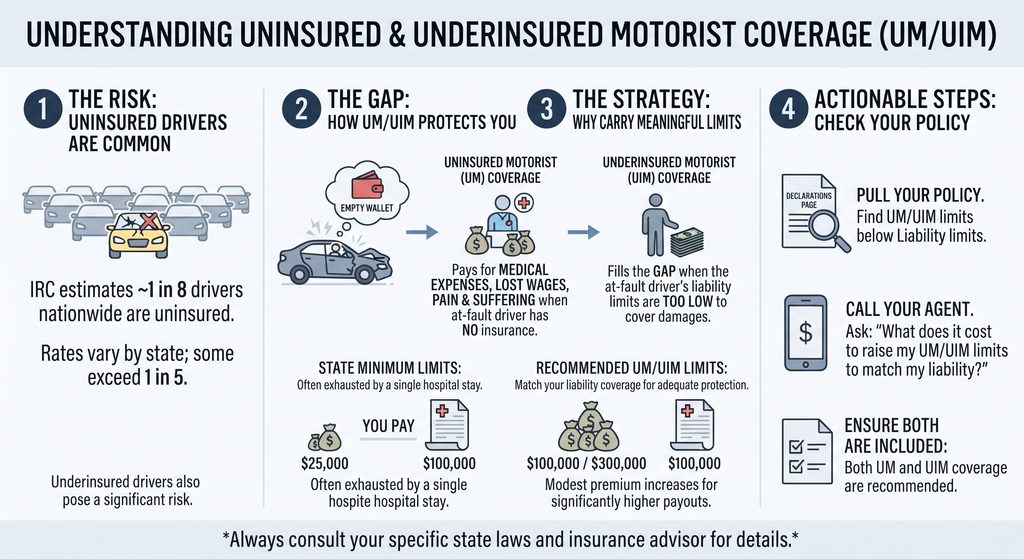
The Insurance Research Council, part of the Triple-I network, estimated that roughly one in eight drivers nationwide was uninsured as of its most recent nationwide analysis. Rates vary sharply by state. Some states see uninsured driver rates well above one in five. Underinsured drivers, who carry a policy but with limits too low to cover a serious accident’s damages, add to the exposure without showing up in that headline statistic at all.
Uninsured motorist bodily injury coverage pays for medical expenses, lost wages, and pain and suffering when the at-fault driver has no insurance. Underinsured motorist coverage fills the gap when the at-fault driver’s liability limits are too low to fully cover the damages. It pays the difference up to your own policy limit. Some states also offer uninsured motorist property damage coverage, which pays for vehicle repairs rather than injuries. That varies significantly by state and sometimes overlaps with collision coverage you may already carry.
Why state minimums are not enough
Many states set minimum liability requirements far below the cost of a serious injury claim. A policy at the legal minimum can be exhausted by a single hospital stay. Because uninsured and underinsured motorist limits typically mirror your own liability limits by default, someone who bought the state minimum in liability coverage is also carrying the state minimum in protection against an uninsured driver. That is precisely the situation where more coverage is most likely to be needed.
Insurance advisors generally recommend matching uninsured and underinsured motorist limits to at least the same level as your liability coverage. Increase both together. The added cost for higher UM/UIM limits is typically modest compared to raising liability limits alone. A few dollars a month can mean the difference between a $25,000 payout and a $100,000 payout after a serious accident.
Where this overlaps with other coverage
Uninsured motorist coverage is distinct from the kind of gaps that show up in rideshare driving. A driver’s personal policy may exclude coverage entirely during certain phases of a ride. For that specific scenario, see this breakdown of rideshare coverage gaps. Uninsured motorist protection and rideshare gap coverage address two different holes in a typical policy. Carrying adequate limits on one does not substitute for the other.
There is also a common misconception that health insurance makes UM/UIM redundant. It does not. Health insurance covers medical bills, but it does not cover lost wages, pain and suffering, or the difference between what your health plan pays and what the provider bills. UM/UIM fills those gaps. In a serious accident, the lost wage component alone can dwarf the medical bills.
What to check on your policy
Pull out your declarations page and find the UM/UIM limits. They are usually listed right below your liability limits. If they match your state minimum, that is a problem. If they are lower than your liability limits, that is also a problem. The two should be equal or close to it.
Call your agent and ask two questions. What would it cost to raise my UM/UIM limits to match my liability limits? And does my policy include underinsured motorist coverage, or only uninsured? Some states require both. Some only require uninsured. You want both.
The cost difference is usually smaller than people expect. Going from state minimum UM/UIM to $100,000/$300,000 often adds only a few dollars a month. That is cheap protection against a risk that roughly one in eight drivers on the road represents.
Given how common uninsured and underinsured drivers are, this coverage is one of the least expensive ways to protect against a real and statistically significant risk. Checking your current limits against your liability coverage takes a five-minute call to an agent. For most drivers, raising them is worth the modest premium increase.