Adding someone as an authorized user is one of the fastest ways to hand them years of credit history overnight. It’s also one of the easiest ways to hand them someone else’s mistakes. Both outcomes ride on the same account. That’s why the arrangement deserves more thought than “add them and see what happens.”
How the boost actually works
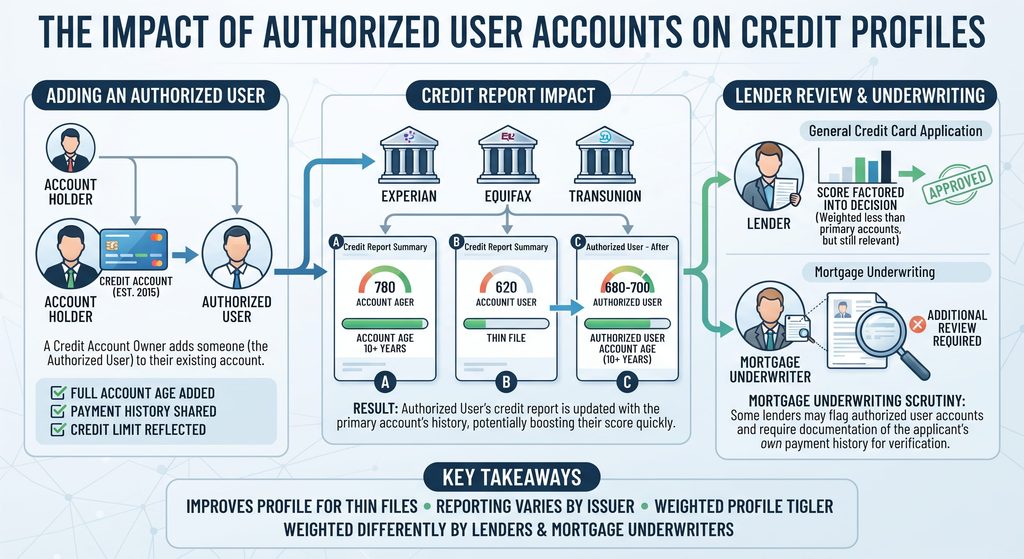
An authorized user is someone a credit card company lets use an account without being legally responsible for the debt. When the issuer reports the account to the credit bureaus, it can show up on the authorized user’s report too. That includes the account’s full age, limit, and payment history. For someone with a thin file, being added to a card with years of on-time payments and low utilization can meaningfully improve their profile in a short window. myFICO confirms that authorized user accounts do factor into the score, though recent FICO models weight them somewhat less than accounts you hold directly.
Not every issuer reports authorized user status the same way. Not every lender treats it the same way when reviewing an application, either. Some mortgage underwriters give it less weight than accounts a borrower opened themselves. A loan officer at a national mortgage lender told me her underwriting team flags authorized user accounts and asks applicants to document their own payment history separately.
The shared risk nobody mentions
Experian points out an asymmetry that catches people off guard. If the primary cardholder runs up the balance or misses a payment, that damage can show up on the authorized user’s report too. Experian does not report negative information back to the primary cardholder from an authorized user’s own behavior. The risk mostly flows one direction, from primary user to authorized user. That’s exactly why this should stay within family or a similarly high-trust relationship, not a favor for an acquaintance.
If the arrangement turns sour, an authorized user isn’t legally responsible for the balance and can ask to be removed. Removal usually drops the account from their credit report going forward. That can cause a score dip if the account was a strong one, or a bump if it was carrying a high balance.
Using it as a bridge, not a foundation
Authorized user status works best as a temporary lift while someone builds their own credit history through accounts they control directly, like a starter card or a credit-builder loan. For a broader look at building credit the sustainable way, see this guide on building credit responsibly.
The pattern I’ve seen work most reliably: a parent adds a teenager to a low-utilization card they’ve held for years, uses it for one small recurring charge, pays it off monthly, then removes the teenager once they’ve opened and managed their own card for six months. The boost is temporary by design. The goal is to build enough independent history that the authorized user account stops mattering.
The arrangement isn’t a substitute for that groundwork. It’s a head start. Once the authorized user has their own accounts in good standing, the primary card’s role in their file matters less. The risk of one person’s mistake dragging down someone else’s score fades along with it.