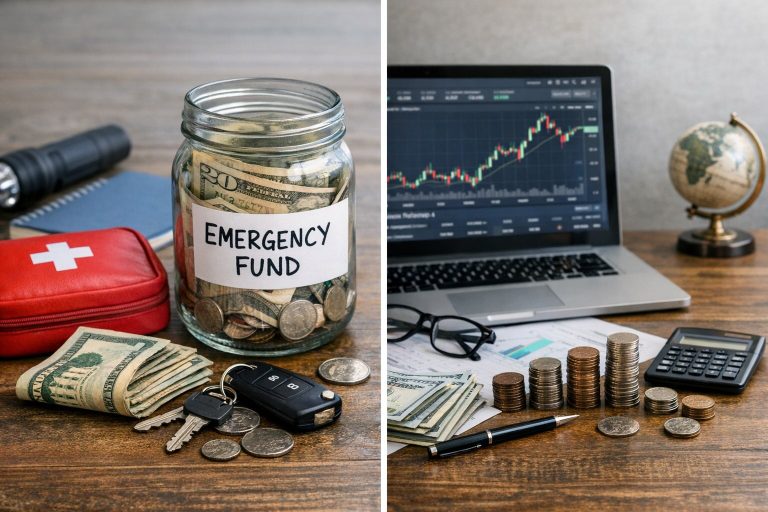
Investing has a reputation for requiring large sums of money before you can get started. That reputation is outdated and no longer reflects how modern investing actually works. Today you can build a genuine investment portfolio with as little as twenty-five to one hundred dollars, and the most important thing you bring to the table is not your starting balance but your consistency and your timeline.
Starting small is not a compromise. It is the right move for anyone who is new to investing, still building an emergency fund, or managing a tight budget alongside financial goals. The habits and understanding you develop while investing modest amounts are exactly what serve you when your income grows and your portfolio with it.
Choose the Right Account Type Before You Invest a Single Dollar
The account you invest through matters as much as what you invest in. A tax-advantaged account like a Roth IRA or a traditional IRA protects your investment growth from taxes in ways that a standard brokerage account does not. A Roth IRA, for example, lets your money grow completely tax-free, and qualified withdrawals in retirement are not taxed at all. For a beginning investor with limited funds, that tax protection is one of the most powerful compounding advantages available.
If your employer offers a 401(k) with a company match, that match is the highest guaranteed return you will find anywhere in investing. A 50 percent match on your contributions up to six percent of your salary is effectively a 50 percent instant return before your money earns a single point of market growth. Contributing at least enough to capture the full employer match is the first investment priority for anyone with access to a workplace retirement plan.
A standard taxable brokerage account is the right choice when you have already maxed out tax-advantaged options or need access to your money before retirement age without penalty. Contributions to a taxable account have no annual limits, and you can withdraw funds at any time. The trade-off is that dividends and capital gains are subject to income tax each year, which reduces the compounding effect somewhat compared to a tax-sheltered account.
Opening any of these accounts now takes less than fifteen minutes online with most major brokerages. Many platforms have eliminated minimum deposit requirements entirely, meaning a ten-dollar deposit is enough to open and fund an account today. The most important action is simply starting, because time in the market produces results that waiting to accumulate a larger starting balance never can.
What to Actually Invest In When You Are Starting Out
Index funds are the most practical starting investment for almost every beginner. An index fund tracks a broad market index like the S&P 500 and gives you ownership of hundreds or thousands of companies through a single purchase. This instant diversification means a single bad stock does not sink your portfolio. The low expense ratios on index funds, often as little as 0.03 percent annually, mean almost none of your returns are eaten by fees.
Target-date funds are another beginner-friendly option worth knowing about. You pick the fund closest to your expected retirement year, and the fund automatically adjusts its mix of stocks and bonds over time, becoming more conservative as you approach retirement. This set-and-forget structure removes the need to rebalance your portfolio manually and makes consistent long-term investing straightforward even for people who have never studied financial markets.
What is dollar-cost averaging and why it works is a question worth exploring early in your investing journey, because it describes the single most important habit for a new investor with limited funds. Dollar-cost averaging means investing a fixed amount on a regular schedule, such as fifty dollars every two weeks, regardless of what the market is doing. When prices are high you buy fewer shares, and when prices are low you buy more. Over time this approach smooths out the impact of market volatility and builds wealth reliably without requiring you to time the market.
Exchange-traded funds, or ETFs, work similarly to index funds but trade throughout the day like individual stocks. Many ETFs have no minimum investment requirement and can be purchased as fractional shares on most modern brokerage platforms. This flexibility makes ETFs particularly accessible for investors starting with small amounts who want broad market exposure without committing to a full share price of any single fund.
Habits That Separate Investors Who Build Wealth from Those Who Do Not
Automation is the single most powerful habit in long-term investing for people with limited funds. Setting up an automatic transfer from your checking account to your investment account on every payday removes the decision entirely. You never have to remember to invest, never have to resist the temptation to spend the money first, and never miss a contribution because life got busy. The money moves before you have a chance to redirect it elsewhere.
Reinvesting dividends is another habit that accelerates portfolio growth without requiring any additional money from your budget. Most brokerage accounts offer automatic dividend reinvestment, where any dividends your investments pay are immediately used to purchase more shares of the same fund. Over years and decades, this compounding of dividends on top of dividends becomes a meaningful driver of total portfolio growth.
Avoiding the temptation to check your portfolio daily is harder than it sounds but genuinely important. Short-term market drops are normal and temporary, but watching them in real time triggers emotional responses that lead to poor decisions, like selling during a dip and locking in a loss that would have recovered on its own. Checking your portfolio once a month or once a quarter is enough to stay informed without the emotional noise that daily watching creates.
Increasing your contribution amount whenever your income grows is the habit that separates people who build meaningful wealth from those who invest consistently but never move the needle significantly. A raise of two hundred dollars per month is a natural opportunity to redirect half of that increase into your investment account before your lifestyle adjusts to absorb the full amount. These incremental increases compound on top of your existing balance and accelerate your timeline without requiring any dramatic sacrifice in your current spending.
A starter investment portfolio does not need to be large, complicated, or perfectly timed. It needs to exist, to grow consistently through regular contributions, and to stay invested through the market’s inevitable ups and downs. Open the right account, choose a broad index fund, automate your contributions, and give your money the one resource that no amount of starting capital replaces, which is time.